
 |
||

|
 2025 MLK Records Releases |
|
The MLK Assassination Files Release: An Overview
The Mary Ferrell Foundation's new collection of Martin Luther King Jr. assassination records consists of 243,496 pages of files, mainly from the FBI and in some cases other agencies. They were released by the United States government on July 21, 2025 pursuant to Executive Order 14176. Dr. King was murdered on April 4th, 1968 in Memphis, Tennessee. Although his accused assassin, James Earl Ray, confessed to the crime to a jury on March 10, 1969, earning a 99 year sentence, Ray soon publicly recanted the admission and maintained his complete innocence while attempting to void his sentence until he died in 1997. Controversy surrounding Dr. King’s murder began not long after he died on the balcony of the Lorraine Motel. The Mary Ferrell website has organized this quarter-million page collection into three major tranches of material. These tranches augment the (partial) Central Headquarters file and other documents that the Mary Ferrell Foundation has featured online for almost two decades.
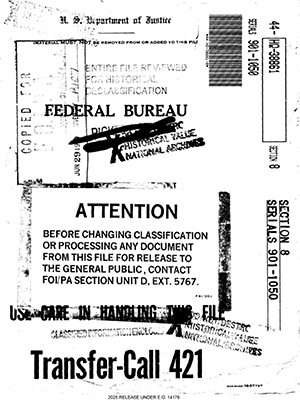
The largest tranche consists of over 200,000 pages and represents what are known as the Federal Bureau of Investigation Murder of Martin Luther King (MURKIN) files. The MURKIN investigation began soon after the murder and was part of one of the largest manhunts the nation has ever seen. It involved — and the Mary Ferrell files are organized according to — every one of the 55 city-based FBI field offices in the nation as well as a handful of foreign FBI stations. Additionally, FBI Headquarters became a clearinghouse that synthesized much of this material in the case. This is the headquarters (HQ) file, not to be confused with the Washington, D.C. Field Office (WFO) files, also contained in the collection. The files are also identified by the FBI classification system, with common classification codes being 44- (FBI Investigative Homicide – Civil Rights) and 157- (Civil Unrest) but also administrative files often beginning with 62- which contain bulky or lab reports on physical evidence. The second code refers to the field office. A typical field office file will thus look like FBI MURKIN Atlanta Field Office (44-2386).
A major structural feature of the MURKIN files is the use of “Subfiles” and “Exhibits.” In general, the “Vol” (Volume) or Serial-stream files represent the straight chronological investigative paperwork (FD-302 interview write-ups, teletype transmissions, office memos, reports, Airtels, etc). Subfiles (often lettered A, B, C or A-1, A-2, etc.) represent topical collections: batches of 302s (witness interviews) grouped together, or press clippings grouped for one lead, or correspondence grouped for one city. Exhibits—usually labeled with a “1A” prefix—are the physical and photographic evidence streams: photos of Ray, photos of suspect vehicles, physical bullet exhibits, cartridge comparisons, fingerprints, and so forth. For example, a file named “Vol 1 Sub 1A (Exhibits – Photographs 1A1–1A27)” might consist entirely of 27 physical evidence photographs used to help the public and law enforcement identify Ray while he was at-large in 1968. Subfiles and Exhibits therefore show what type of material is contained inside and how the field offices separated that material from the pure chronological paperwork.
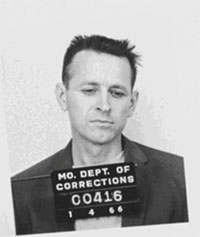
The largest MURKIN field office files correspond to the geography of James Earl Ray’s life, from his birth and early criminal activity in The largest MURKIN files correspond to the geography of James Earl Ray’s life — from his birth and early criminal activity in St. Louis (44-775), to his imprisonment in Leavenworth, Kansas and later Springfield, Missouri (44-760 and 44-561), to his escape through Illinois (44-1114), his initial attempts to flee the country from Canada (44-4), and time he spent, sometimes in more than one visit, in Birmingham, Alabama (44-1740), Los Angeles, California (44-1574), New Orleans, Louisiana (157-10673), and Atlanta, Georgia (44-2386). This included a sojourn to Mexico in 1967. The Memphis file, which includes the direct investigation of the shooting itself, served as a central organizing point for much of the investigation (Memphis – 44-1987). One will find additional Royal Canadian Mounted Police files (again, Ottawa – 44-4) detailing Ray’s successful effort to flee North America, and records of his eventual arrest and extradition from England in the London Field Office files (London – 88-228).
Much of this material shows the evolution of the investigation as it first considered the possibility of a multi-assassin conspiracy involving the three identities tied directly to the evidence found in the green blanket outside Canipe’s amusement store: Eric Starvo Galt, Harvey Lowmeyer, and John Willard—until further investigation eventually revealed that all three "people" were aliases (fake names) used by James Earl Ray. The Jackson field office (Jackson – 157-9586) offered many leads on conspiracy angles until Attorney General Ramsey Clark and FBI Director J. Edgar Hoover began shutting down all avenues suggesting that anyone other than Ray was involved in the killing.
But the materials do include leads generated years after the original 1968–69 investigation, as late as the early 2000s. Some of that involves interactions with the House Select Committee on Assassinations (HSCA) in 1978. Much attention has been paid to the HSCA’s investigation of the JFK assassination and the tens of thousands of pages of original investigative material developed and released to the public under the JFK Records and Collection Act. Records of the HSCA's concurrent investigation, which concluded that there was a likely conspiracy in the MLK murder, remain under seal by Congress and none of them are available in the material released in July. This will hopefully be a major avenue of future releases facilitated by the House Task Force on the Declassification of Federal Secrets, chaired by Congresswoman Anna Paulina-Luna.
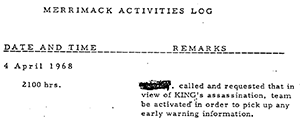
There is, however, a second tranche of records that consists mostly of intelligence and surveillance files related to the civil unrest following MLK’s assassination. Much of this comes from a little-known CIA program known as Operation Merrimack, that monitored anti-war and other domestic dissent groups and sometimes intersected with coverage of civil rights. Mary Ferrell has a separate collection for that material, which also includes related files. This is not to be confused with the FBI’s COINTELPRO investigations, the CIA’s CHAOS program, or the Pentagon’s surveillance and domestic activities related to civil unrest, such as Operation Garden Plot. These do not appear, in any substantive way, in the July released materials. The second tranche, as a percentage of total records, is much smaller than the MURKIN material.
Finally, there is a third tranche of records which consists of "RIF files" - files numbered by the Assassinations Record Review Board (all CIA-originated) and placed in the JFK Collection. A good portion of these files are primarily focused on the JFK assassination and not the MLK assassination, but often in matters where some overlap exists.
- Stuart Wexler, November 11, 2025
Stuart Wexler is co-author of The Awful Grace of God: Religious Terrorism, White Supremacy, and the Unasolved Murder of Martin Luther King, Jr. with Larry Hancock. He is also the author of the new book America's Secret Jihad: The Hidden History of Religious Terrorism in the United States.
Publishers's Note on this New Collection:
This collection is a major addition to the Mary Ferrell Document Archive. While no document collection is ever complete - in particular MFF's set of Martin Luther King Jr. assassination documents is missing court transcripts and records - these new files turn the MLK collection into a major resource of primary source materials. Government records may not by themselves "solve the case" in these still-debated political murders, but they are a critical base of information for those who study them.
Researchers may notice that the files do not appear to match the 6,302 pdf files put online by the National Archives on July 21. In fact the content is the same, except that MFF has combined many files and renamed them all. NARA had arbitrarily broken files into 50-page segments; these have been merged into full logical files (to 2,306 files).
Then, with the help of MLK assassination and FBI files expert Stuart Wexler, we renamed all of the files to describe their contents. For example, the 9 NARA files "44-hq-38861_hs1-233652821_01-03-part_1_of_9.pdf" through "44-hq-38861_hs1-233652821_01-03-part_9_of_9.pdf" were merged together into one file named "FBI MURKIN - Headquarters [44-38861] - Section 3, Serials 251-375.pdf." Below is a partial listing of the results of this renaming:
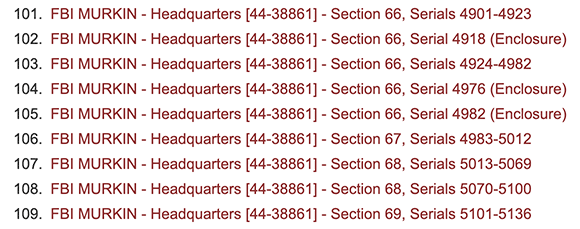
The MFF naming captures the volume and serial filing system of the original FBI files. We named and divided the FBI field office files by city, and renamed other files to make them as sensible as possible. The RIF-based CIA files were retitled based on the titles in NARA's JFK Collection, and have been added to our growing JFK Database Explorer.
Many thanks to Stu for his diligent and expert work helping us rename and organize this collection into these logical subsets:
- FBI MURKIN Headquarters Files - the central headquarters files of the MURKIN investigation (59,976 pages in 377 documents)
- FBI MURKIN Field Office Files - field office files for 50 cities (155,450 pages in 804 docs)
- JFK Collection CIA Files - files from the JFK Collection which relate to the King assassination or investigations (10,939 pages in 968 docs)
- FBI MURKIN Index Cards - Index cards which map names to file references (13,350 pages in 7 docs)
- Miscellaneous files related to the 1970s investigations, Project Merrimack, and other topics (3,781 pages in 150 docs)
A debt of gratitude is also owed to the Assassination Archives and Research Center, which two decades ago provided the original MLK assassination files used to kickstart our collection.